Showing posts with label Italian food. Show all posts

Wednesday, March 27, 2019

How Did Italian Food Conquer the World?

Doesn't that just make you think of Bavaria?
I’m not disputing the title of John F. Mariani’s How Italian Food Conquered the World, since like Mariani, I’ve seen Italian restaurants all over the world, with some particular hot spots. In a recent trip to Kolkata, India, I noticed there were several Italian restaurants. Even though some were recommended by the locals, I did not eat in them.[1]

Nor did I eat in Italian restaurants in Japan. Japanese restaurants typically display photos or models of the food. In a land where there’s a cuisine built around the artful arrangement of food (kaiseki), Italian food gets presented as something you might refuse to eat on a dare. Even the worst red sauce joint might look at it and say, “did you just hurl it on the plate?”[2]

Then there was the trip to a town in Germany where it seemed that Italian restaurants outnumbered the German ones (and if you got tired of wurst and sauerkraut, well, there was Italian), including one where Germans sang Italian songs while waiters served Italian dishes. Many of these Italian restaurants are staffed by Italians. To make it clear: I am not disputing Mariani’s contention, just wondering if he’s made his case.

A small error of geography.
His book gets off to a shaky start, since on pages 7 and 10, I found two errors of fact. First tells us that vomitoria were rooms were Romans would force themselves to vomit so they could go back to eating; these tales of bulimia in antiquity are fantasies based on a fourth-century word for “stadium exit.”

Nor is it the case that Vasco da Gama visited Calcutta (or Kolkata, founded 1690) in 1498. How could he? He sailed to Calikat (modern Kozhikokde). Kolkata is Northwest India, Kozhikode in Southwest India, and they’re only separated by about a thousand miles, so just a small sloppy mistake, likes those plates of pasta in Japan.

Another of Mariani’s problems is that as a food and travel writer for Esquire, his real expertise is in destination restaurants, not food history. Does he make the case that Italian fine dining is how Italian food conquered the world? No. Does he know a lot about Italian fine dining. Yes. Does he name drop like a status-hungry socialite? Absolutlely.

Take these two sentences from the end of a paragraph:
Living above the restaurant until she died at the age of 97, Bice was known for her egalitarian approach to her guests, rich or not, famous or from nowhere, and she got along with everyone. Once when Sophia Loren entered the room, everyone applauded.
Can we assume that those who were neither wealthy nor famous (like humble and obscure Sophia Loren) were applauded when they walked into Bice? The next paragraph tells that restaurant was always packed when the designers showed off their collections in Milan. On this one page, Mariani finds room to reference Gina Lollabrigida, Ingrid Berman, Franco Zeffirelli, Gianni Versace, before he gets to Sophia Loren, and the fashion houses Burberry and Gucci.

Was it through Italian food nudging French food aside as fashionable dining that Italian food conquered the world? Given that those restaurants in Japan and India and some in Germany were the more humble sort (red sauce joints, really), it’s tough to say that the success of the Bice Group (from that one restaurant in Milan to locations around the world) was conquest for anything other than one company specializing in upscale dining.

Not wholly trustworthy.
It’s not long after this that in his discussion of upscale dining that Mariani simply asserts that by this point Italian food had conquered the world, without any evidence of this sudden capitulation. When did that happen and how?

Although it’s a bit of a non-sequitur in his telling (though undoubtably important in how Italian food conquered the world), Mariani has a good chapter early in the book on the rise of the Mafia-themed pizza parlor, part of a broader context of Italian food wrapped in ethnic stereotypes and slurs, with sniggering suggestions that Italian-Americans can’t really master English and they all have connections to organized crime. Long after Italian immigrants stopped serving up low-grade Italian-American food, it’s been adopted by corporate restaurant concepts.

In a way, it’s not far from the upscale dining, often just a different sort of restaurant packaging. Mariani doesn’t cover how Italian restaurants on every level aren’t family trattorias, but packaged by corporations (from Bice and Il Fornaio with roots in Italy to Buca da Beppo founded in the Midwest and owned by Planet Hollywood). That Italian food can be readily marketed on a global scale is part of this story. (The only type of food more relentlessly churned out by corporate America is, of course, the burger joint, though that’s only one segment of dining, while Italian restaurants can be found in several.[3] The number Dunkin’ Donuts locations in Germany indicate that the next level down is open for conquest.[4])

In Mariani’s telling, Italian food had yet to conquer the world when any supermarket in the United States already had extensive quantities of Italian food in their aisles. Again, this is Mariani focusing on the sort of dining he writes about in Esquire and completely failing to look supermarket shelves which have been home to Italian foods for decades. Ragú, now owned by a Japanese company, was founded in New York in 1937. I grew up with ads that told Massachusetts residents that “Wednesday is Prince Spaghetti day.”[5] Mariani doesn’t mention how the Italian food on supermarket shelves is increasingly the product of global food conglomerates. Maximizing the profits of companies with no connection to Italy or people of Italian descent is part of that story. When someone in the Midwest pours a jar of sauce from a company headquartered in Japan on pasta from a company headquartered in Spain and tells themself that they’re eating Italian, Italian food has conquered the world (without any actual involvement by Italians).

At turns inaccurate, gossipy, and too focused on Mariani’s experience going to nice restaurants for Esquire, How Italian Food Conquered the World never actually answers how. Yet, Italian food really did conquer the world. Great title. The book, not so.


  1. I ate Indian food in India, mostly Bengali food, since I was in West Bengal. I didn’t actually trust the Bengali cooks to turn out Italian food I wanted to eat. Besides, there was so much good, authentic Indian food to have.  ↩
  2. Again, why eat ugly, poorly-made Italian when there was so much good local food to eat? Eating in Japan was an experience of almost no two restaurants alike (I had sushi more than once), since there’s such specialization in Japanese food. There was no overlap between the place the served only eel, the place served only crab, and the place that served only fugu. That’s a different blog post.  ↩
  3. Throwing this in a footnote. Burger and pizza: fast food. Pasta places are typically family dining. Things slide from there to casual dining to fine dining. These are best typified by the beverage choices: no wine, house red or house Chianti (glasses and carafes only), a wine list, an expensive wine list.  ↩
  4. As much as I like their Bavarian cream donuts, I just don’t see myself having one in Bavaria.  ↩
  5. Founded on Prince St. in Boston in 1912 (just blocks from the site of the 1919 molasses flood). It is now owned by the US subsidiary of a Spanish corporation.  ↩

You can follow my blog on Twitter (@impofthediverse) or on Facebook. If you like this post, share it with your friends. If you have a comment just for me, e-mail me at impofthediverse@gmail.com.
This blog runs solely on ego! Follow this blog! Comment on this post! Let me know that you want to read more of it!

Tuesday, May 19, 2015

Torta Caprese

A food stylist would have removed
the crumbs. The yummy crumbs.
If the slice of torta caprese that I had on Capri wasn’t my first one, it was certainly a memorable one. There I was, sheltered under a tree on the patio of a trattoria, ready for something to eat and drink. We paired it with espresso, which is a wholly non-Italian thing to do, but the Italians aren’t sticklers in matter of food and drink. Its possible that it was my first piece of torta caprase, since it probably falls into the category of “Italian desserts that don’t show up much in American restaurants.”

There are hundreds of Italian desserts—dolci—but the same ones keep showing up on the menus of Italian restaurants again and again. There’s always the tiramisu, which (according to Wikipedia) isn’t terribly old. Then again, neither is torta caprese, which seems to be another invention of the twentieth century. One site notes that none of its ingredients are specific to Capri. The principal ingredient—chocolate—is foreign to Italy. (Wikipeida notes that Italy produces about 110,000 metric tons of almonds per year, but Italy is not among the countries where the cacao tree is grown.)


You can follow my blog on Twitter (@impofthediverse) or on Facebook. If you like this post, share it with your friends. If you have a comment just for me, e-mail me at impofthediverse@gmail.com.
This blog runs solely on ego! Follow this blog! Comment on this post! Let me know that you want to read more of it!

Saturday, December 20, 2014

Rice Fritters for Hanukkah

Fritelle di Riso
Here's a great way to end your Hanukkah meal (after you’ve had Hanukkah gelt on your dinner plate). Like the carote alla guidia, this dish comes from the culinary traditions of the Jews of Italy. Since I’m of Italian descent,[1] these dishes resonate with me.[2] I really like rice-based desserts, as one of my family’s great traditional dishes is another rice-based dessert.[3]

This recipe comes from The Classic Dolci of the Italian Jews; A World of Jewish Desserts, by Edda Servi Machlin. Machlin was born in Pitigliano, a village in Tuscany, later emigrating to the United States. In a way, they’re sort of the Italian dessert version of latkes, and when they’re cooking in the skillet, if it weren’t for the presence of the raisins, they would look very much like them (rice, potatoes—little bits of starch). The recipes are even fairly similar, as you have starch bound together with egg then fried. No onions in these though. Save those for your latkes.

You can follow my blog on Twitter (@impofthediverse) or on Facebook. If you like this post, share it with your friends. If you have a comment just for me, e-mail me at impofthediverse@gmail.com.
This blog runs solely on ego! Follow this blog! Comment on this post! Let me know that you want to read more of it!

Wednesday, December 17, 2014

Hanukkah Gelt for Dinner!

Oh? Were you expecting chocolate?
It’s every child’s dream, right? No, I’m not suggesting that anyone fill their plate with chocolate coins. Sorry. But there is another way. Think: if you wanted to have golden coins on your plate for Hanukkah dinner, what would you use? Carrots!

It’s traditional. The traditional Hanukkah dish for Ashkenazi Jews is latkes. I love latkes, all crunchy and wonderful. I have heard that Israeli tradition is jelly doughnuts, sufganiyot, which are deep fried and then filled. It’s not the same. You can fry carrots. Seriously. Then you have the traditional dish of Italian Jews, carote alla giudia, which I make year round. I only have latkes at Hanukkah: they’re a lot of work and they’re oily. But braised carrots are easy and not that bad for you. You use oil and it looks like coins! What could be more appropriate?

I’ve made this for years, and honestly it works better as a series of ideas, instead of hard-and-fast measurement. It scales pretty well, if you pan is big enough. I use a big skillet and cook about six carrots at the same time, that’s probably about a pound or a pound-and-a-half.


You can follow my blog on Twitter (@impofthediverse) or on Facebook. If you like this post, share it with your friends. If you have a comment just for me, e-mail me at impofthediverse@gmail.com.
This blog runs solely on ego! Follow this blog! Comment on this post! Let me know that you want to read more of it!

Saturday, October 18, 2014

Bolognese, the Right Recipe for Lamb Neck

Lamb bolognese.
Previously, I wrote about an attempt at braising lamb neck that didn’t come out with the right balance of flavors.[1] It didn’t stop me from using lamb neck, because I found that there was another dish where it worked nicely. The only problem is getting the meat off.

I often make a bolognese with stew beef. It’s convenient and quick. Many recipes call for ground beef (i.e. hamburger), but I find that the meat has been ground too fine, leading to a somewhat gritty texture. So, instead, I throw the cubes of beef into the food processor, pulse, and then I have my chopped up meat for the sauce.[2] If I’m up for a little more work, I do it with lamb instead.

Consider the lamb neck: meat, fat, and connective tissue wrapped around a funny-shaped bone. It’s actually a bit of work to get the meat off these things. But, on the other hand, it’s just the sort of meat you want to send into a bolognese. You cut as much of the fat off as you can, then clean the bones of as much meat as you can (there’s always going to be some left connected, but I’ve saved the bones for stock[3]).


You can follow my blog on Twitter (@impofthediverse) or on Facebook. If you like this post, share it with your friends. If you have a comment just for me, e-mail me at impofthediverse@gmail.com.
This blog runs solely on ego! Follow this blog! Comment on this post! Let me know that you want to read more of it!

Saturday, July 5, 2014

Chocolate Polenta Pudding Cake

Chocolate polenta pudding cake
A few years ago, a friend showed me his copy of Lynne Rossetto Kaspar’s book The Italian Country Table as a possible inspiration for some cooking. At the time, he lived in an apartment with a very small kitchen, so he came over one day to “borrow” my kitchen, just to make something. We made an entire meal from this cookbook, and later I went and got my own copy.

I forget which recipes we made other than chocolate polenta pudding cake, and this is the one that I’ve made many times since. I’ve been making it for my mother-in-law’s birthday for several years now, since it brings together many things she likes (including chocolate). It’s a bit of a bear of a recipe, since it starts with making sweet polenta, but the result is an incredible chocolate cake with a creamy interior.


You can follow my blog on Twitter (@impofthediverse) or on Facebook. If you like this post, share it with your friends. If you have a comment just for me, e-mail me at impofthediverse@gmail.com.
This blog runs solely on ego! Follow this blog! Comment on this post! Let me know that you want to read more of it!
Tuesday, June 24, 2014

How Sweet to Taste the Amari at L’Artusi

A nice plate of lamb
L’Artusi, in New York City’s West Village seeks to “demystify” Italy, though I hadn’t been aware that Italian cuisine was all that mysterious. The restaurant is lively with happy sound, or as some might call it, noisy. Despite this, it is more spacious than Lupa; no worrying that you’re going to bring the next table down should you get up from your seat. And, although the food and atmosphere at L’Artusi is much more casual, the waitstaff is much more formal. “Yes, sir.” “Certainly, sir.” I’m not knocking the experience; when you go an shell out your cash on a meal, it’s nice to be treated as someone who might enjoy a touch of deference.

The runners made one mistake that the wait staff quickly rectified. James and I both ordered salads; I additionally ordered the beef carpaccio. My salad and the beef came at the same time. I caught the attention of the hostess and asked that the carpaccio be parked somewhere cold until we were ready for it. “Certainly not, we’ll make you a fresh one when you’re ready for it.” The salads were immense. James’s resembled a great shaggy mountain with the cheese that was grated on it. We were able to finish these, then the table was cleared and a carpaccio appeared ready for us to share. It worked better after the salads anyway.


You can follow my blog on Twitter (@impofthediverse) or on Facebook. If you like this post, share it with your friends. If you have a comment just for me, e-mail me at impofthediverse@gmail.com.
This blog runs solely on ego! Follow this blog! Comment on this post! Let me know that you want to read more of it!

Sunday, June 22, 2014

Lupa, Satisfying Food at Close Quarters

I would have happily eaten more.
Before we walked to Lupa, Mario Batali’s “Osteria Romana” in Greenwich Village, we checked out Eric Asimov’s review in The New York Times. Shorter Asimov: Lupa is inconveniently crowded. That was certainly true, but first let’s get there.

We walked over. Things seemed quiet. No line. We read the menu. Ninety-minute wait for a table. We were advised to check back in about a half hour. We wandered about for a bit, returning to the restaurant about a half hour later. We were told it would be another forty-five minutes, but they actually sat us about fifteen minutes later. Were it not New York, I’d probably worry about starting dinner past 10 at night. Not so much a problem here. I did notice, however, that the restaurant did clear out while we were having our dinner. We weren’t the last to be seated, but we were a late seating.

We were shown to a table right next to a passageway to a service area. Waitstaff came in and out of this for various reasons. The focaccia and olive oil were plated up here. After about the fifth time someone grazed my elbow, I suggested to James that we quietly move the table two inches closer to the next table. He offered to swap seats with me, but I pointed out that as he is larger than I am, he was only going to be a bigger target. Once we shifted out of the traffic path, I was bumped into no more. (And when the party at an adjacent table cleared out, that gave the staff even more room. I gave a silent thanks to the woman who admonished a gentleman in her party that “chairs don’t push themselves in.”)

We did better than the couple at the next table. A person at the table beyond theirs, returning to his seat accidentally knocked their salumi platter to the floor. The staff was very apologetic to the couple. They declined getting a replacement salumi platter, so I assume the restaurant simply took it off the bill.
Careful, you could choke someone
on those


You can follow my blog on Twitter (@impofthediverse) or on Facebook. If you like this post, share it with your friends. If you have a comment just for me, e-mail me at impofthediverse@gmail.com.
This blog runs solely on ego! Follow this blog! Comment on this post! Let me know that you want to read more of it!

Wednesday, June 18, 2014

Fresh Pasta Is Good, 00 Flour Makes it Better

Waiting for the pot
Lately, I’ve been making a lot of pasta. Pasta has been a major part of our diet (this should not seem surprising for the household of an Italian-American who grew up in the region that got the “Wednesday is Prince spaghetti day” commercials). Given a choice between water-based pasta that has been par cooked and dried and fresh egg pasta, there really is no choice. Go for the fresh.

I’ll admit right here that most people have the sort of busy lives in which rolling out fresh pasta is is going to be a rare occurrence. Just not going to happen for a typical person on a Tuesday night. For those people, I would encourage them to make it when they can. When you do make it, I also encourage you to make it the best you can.

When I started making pasta (about seven years ago; I came late to it), I bought a bag of Italian 00 flour. It was expensive, probably about $8 for a 1 kilogram sack (about two pounds). Worse, because it was expensive, I wanted to save it for special occasions. Eventually, the flour went stale or got bugs, or whatever else happens to flour that you’re not actually using, which made it even more expensive.


You can follow my blog on Twitter (@impofthediverse) or on Facebook. If you like this post, share it with your friends. If you have a comment just for me, e-mail me at impofthediverse@gmail.com.
This blog runs solely on ego! Follow this blog! Comment on this post! Let me know that you want to read more of it!

Sunday, June 8, 2014

Red Pasta — Second Attempt

Just a hint of tomato
When I decided that I wanted to make another color of pasta, I hit the web looking for some recipes, since my cookbook listed spinach pasta but no other sorts. Over at About.com, Kyle Phillips said that you couldn't use tomato paste for red pasta since it would make the pasta too acidic for anything but a cream sauce. After finding the carrot pasta recipe there such a trial, I decided to test out the claim about tomato pasta.

I made a standard two-egg recipe, beating a tablespoon of tomato paste into the eggs before adding them to the flour. This made a slightly red, very workable dough. I let it rest for a few minutes, then I kneaded it, then I went off to run some errands.

When we got back, the dough was thoroughly rested and I was ravenous. I think I would have eaten it no matter what. I do have to wait for this to cook? It rolled out as I would expect dough to even without the addition of a tablespoon of tomato paste. I cut into into fettuccine and let it rest while I prepped everything else.


You can follow my blog on Twitter (@impofthediverse) or on Facebook. If you like this post, share it with your friends. If you have a comment just for me, e-mail me at impofthediverse@gmail.com.
This blog runs solely on ego! Follow this blog! Comment on this post! Let me know that you want to read more of it!

Wednesday, June 4, 2014

When You Know the Recipe Must Be Wrong

It will have a deeper
color when cooked
It's not me.

Just a little while ago, I made spinach pasta. I've made it before; it's pretty easy. I wanted a challenge, so I decided to go for another color. Red, or reddish. You can make a red pasta with beets, or a less red one with carrots and tomato paste. I went for the carrots.

You start by dicing the carrots and simmering them in water until they're tender. You puree them, mix in some tomato paste, and then further cook it. The recipe I used said to cook it to a thick paste, which is what I had before anything went into the saucepan. I gently cooked it to drive off some moisture. Then I let it cool.

When I was ready to make the pasta, I beat my carrot mixture with three eggs and added that to 400 grams of flour. It made a pretty wet mixture. I didn't weight the carrot mixture, but it was certainly a greater volume that you would use for spinach, although it did replace an egg (but I'd bet it weighed more than 50 grams).


You can follow my blog on Twitter (@impofthediverse) or on Facebook. If you like this post, share it with your friends. If you have a comment just for me, e-mail me at impofthediverse@gmail.com.
This blog runs solely on ego! Follow this blog! Comment on this post! Let me know that you want to read more of it!

Tuesday, May 20, 2014

Pasta — Going green

Spinach pasts
Spinach pasta. Yummy and easy to make.
In my house, quantities of egg pasta are measured by the egg, as in "how many eggs of pasta should I make?" I also roll out my pasta a half egg at a time. What is an egg of pasta? For me, it's the quantity of egg pasta made with one egg. Although I haven't been putting recipes into this blog, here is my recipe for egg pasta:
Egg pasta
2 eggs
200 grams of flour

For 2 eggs of pasta, I usually just do it on the board or in a bowl, since I don't want to mess up the food processor for a trivial amount of pasta. Four eggs? Food processor. Throw the flour into the bowl of the food processor. Add the eggs one at a time, until they are thoroughly mixed. Pulse the last one, and the mixture will form into a ball (or a bunch of big clumps.

Let the dough hydrate for about 10 minutes, then knead until it is smooth. Let the dough rest about 15 minutes, then roll and cut.  
While I do increment pasta up by the egg, I typically never make less than 1 egg's worth of pasta. And, conversely, I usually top off at 4 eggs. It gets tough to knead after that. Large eggs weigh about 50 grams each, so 2 eggs of pasta is about 300 grams (call it 10 ounces, a nice amount to make for 2 people).

You can follow my blog on Twitter (@impofthediverse) or on Facebook. If you like this post, share it with your friends. If you have a comment just for me, e-mail me at impofthediverse@gmail.com.
This blog runs solely on ego! Follow this blog! Comment on this post! Let me know that you want to read more of it!

Thursday, May 15, 2014

Gnocchi di patate

Gnocchi!
I remember ordering gnocchi in Italy many years ago. I pronounced the word the way Americans typically do, "nok-ee," with the gn as in "gnu." The waiter corrected me. "In Italy, we say 'g-no-ki.'"

I've owned a gnocchi board for years (they're inexpensive), but it's sat unused. "I really need to make gnocchi one of these days," I said time and time again. And the gnocchi board would sit in the pantry, next to the pasta machine. (For the record, in Italian the item is called a tagliere riga.) Today, it was going to get used.

I probably should have consulted more than one cookbook, but I checked the Silver Spoon Cookbook and their recipe seemed like a good one. It's a practical and dependable Italian cookbook. And it's a simple recipe. 2 ½ pounds of potatoes. 1 ¾ cups of flour. A egg. A pinch of salt. All of the recipes in the Silver Spoon Cookbook are short; this is not a cookbook with detailed, step-by-step instructions.
Messy sheet pan
Messy sheet pan


You can follow my blog on Twitter (@impofthediverse) or on Facebook. If you like this post, share it with your friends. If you have a comment just for me, e-mail me at impofthediverse@gmail.com.
This blog runs solely on ego! Follow this blog! Comment on this post! Let me know that you want to read more of it!

Wednesday, May 14, 2014

Because you can't emulate Julia Child all the time

I really have to do this more often, and branch out as well. Making pasta from scratch is neither difficult nor time intensive (just the opposite of chicken roasted in a cassarole with tarragon). I poured out 200 grams of flour, beat two eggs, and mixed it all together.

I then tossed it into the fridge for about a half hour (it needs at least fifteen minutes, but I got distracted because I was writing). Then I kneaded it. Then it gets rolled out.

I haven't made my own pasta as much as I should I'm hoping this batch is a harbinger for more batches of pasta to come.

Tossed with the sauce, it made a wonderful dinner.


You can follow my blog on Twitter (@impofthediverse) or on Facebook. If you like this post, share it with your friends. If you have a comment just for me, e-mail me at impofthediverse@gmail.com.
This blog runs solely on ego! Follow this blog! Comment on this post! Let me know that you want to read more of it!

Sunday, May 11, 2014

The experiment was a failure, but the cake was a success

Butter and chocolate
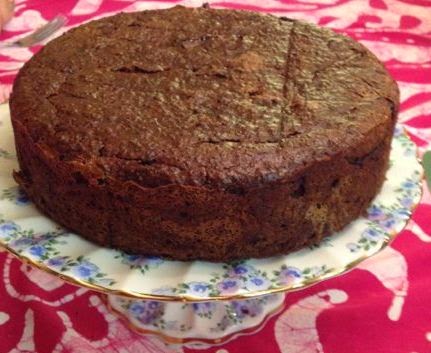
I decided to make a torta caprese for Mother's Day; my mother-in-law likes chocolate. I've been making this for a number of years, but today decided to try something slightly different. Since it is a cake based on beaten egg whites, I thought I'd vary the recipe I've been using to see if I could get a bit more loft. This is not a lofty cake.

The recipe I've been using calls for chopping up chocolate and almonds in a food processor. Ground together, they form a sort of dark, sandy mix. This is added to egg yolks beaten with sugar, to which melted butter has been added. This is not a lo-cal dessert.

Lately, instead of grinding the almonds, I've been using almond meal. It's a lot easier, and the stuff that comes in a bag is a lot more finely ground than I can do in the food processor. But that left me grinding the chocolate still. This time, I wanted to see if melting the chocolate with the butter would improve the cake any.

Melted butter and chocolate
Melted
I measured out my butter (there's a lot of butter in this cake), and then added the broken up bits of chocolate bar. I used the microwave to melt it all. A few 30-second cycles and the everything was melted. I stirred it together. Mmm. Chocolate butter.

I then made the rest of my cake as usual, beating the egg yolks with sugar, adding the butter/chocolate mixture, and then the almond flour. Finally, I folded in the egg white. It looked pretty good in the pan. The question was, would it bake up any higher?


You can follow my blog on Twitter (@impofthediverse) or on Facebook. If you like this post, share it with your friends. If you have a comment just for me, e-mail me at impofthediverse@gmail.com.
This blog runs solely on ego! Follow this blog! Comment on this post! Let me know that you want to read more of it!

Friday, May 9, 2014

Getting my goat…bolognese

This is not a Julia Child recipe.

It's not even French. I'm not even sure if the French eat goat. They must, considering all the things I've seen on the menus of restaurants in France. I mean, if you're going to eat snails, frogs (both very good), and horse, I can't imagine getting all squeamish over goat.

What I'm made was a goat bolognese. You can make practically anything into a bolognese. I had a delightful squab bolognese in a restaurant overlook Padua some years ago (they were tower-raised pigeons; I suppose that means they got to fly around).

I've done it with lamb (lamb shank, very slowly braised makes for a very nice Bolognese). I want to do it with duck (because I'm not getting squab). I do it with beef all the time, but you want some variation. So I chanced on goat.

The supermarket where I bought the beef for the beef bourguignon caters to the local Islamic population. They sell goat. There in the halal display case were goat chunks. Like, goat stew meat, right? Not exactly. When I tried to chop them up in the food processor, I realized that my pound and a half contained about a half a pound of bones. So, grabbed a knife and took the meat off the bones. Then I ground it and browned it a skillet. (The bones went into the freezer for later use for a small pot of meat stock.)


You can follow my blog on Twitter (@impofthediverse) or on Facebook. If you like this post, share it with your friends. If you have a comment just for me, e-mail me at impofthediverse@gmail.com.
This blog runs solely on ego! Follow this blog! Comment on this post! Let me know that you want to read more of it!
Related Posts Plugin for WordPress, Blogger...