Showing posts with label French. Show all posts

Monday, May 8, 2017

Nay to Née

Né? Not for me!
I tend to be fairly conservative in language, preferring the tried-and-true to the innovative, but there is one point where I have to draw the line. There may have been an era in which the use of the French word née didn’t come off as affected or pretentious. We are no longer in that era.

Worse yet, the only times I ever see it, it’s been misused. There are multiple forms. In French there are times in which you would write not only and née, but also •nés* and nées. It’s just the French word for “born” (that is, the past participle of the verb naître). As a convention in English, it’s acquired the meaning of “born under the name of,” and it’s typically used to indicate that some man is performing under a name other than that with which he was born.


You can follow my blog on Twitter (@impofthediverse) or on Facebook. If you like this post, share it with your friends. If you have a comment just for me, e-mail me at impofthediverse@gmail.com.
This blog runs solely on ego! Follow this blog! Comment on this post! Let me know that you want to read more of it!

Friday, December 12, 2014

Professor Schinz, the Accuser of Esperanto

Professor Claims Esperanto a German Plot
To recap: On November 25, 1916, the New York Sun published a letter by Creston Coigne about how Esperanto was progressing despite the war. This occasioned a response on December 2 from Professor Albert Schinz of Smith College, who essentially accused a British Esperantist who was covertly corresponding with a German Esperantist friend of treason, and suggested that the only reason that the Germans were putting war dispatches out in Esperanto was to disrupt the likelihood of French and English being the co-international languages, and advance the cause of German. To this, on December 11, Jozefo Silbernik, Dr. Zamenhof’s brother-in-law, and an active Esperantist in New York City, showed that Professor Schinz’s contention that the Germans did this because they knew they would lose the war was false, since the Germans started the dispatches before getting officially involved in the war.

Not enough for Professor Schinz. On December 12, 1916, he’s back in the pages of the Sun with a further question for the Esperantists. At this point, I had to look ahead; Professor Schinz gets the last word. After initial enthusiasm for Esperanto, French academics had somewhat soured on it, and I suspect Professor Schinz got his view of Esperanto from his French colleagues. His real issue seems to be the prospect of French as one of the world’s languages of international use.


You can follow my blog on Twitter (@impofthediverse) or on Facebook. If you like this post, share it with your friends. If you have a comment just for me, e-mail me at impofthediverse@gmail.com.
This blog runs solely on ego! Follow this blog! Comment on this post! Let me know that you want to read more of it!

Tuesday, December 2, 2014

Esperantists — The Kaiser’s Fools

Professor Albert Schinz
Thought Esperanto
a German plot
So claimed a letter in the New York Sun on December 2, 1916. The Germans had been putting out war dispatches in Esperanto, which some Esperantists viewed as a real success for Esperanto. Albert Schinz, of Northampton, Massachusetts didn’t see it that way.

Just as in 1908, when Esperantists felt that the use of Esperanto by Moresnet would taint Esperanto with regional politics, Professor Schinz felt that the Germans were propagandizing the Esperanto movement. Yes, “Professor Schinz.” It took a small amount of work to determine that Albert Schinz was a professor of French at Smith College when he wrote the letter. He was a fairly prolific scholar with many books and articles to his credit.

If it not clear if he was an Esperantist, however, he does note that he knew Esperantists, and he wrote an article in the January 1906 Atlantic Monthly describing and sympathetic of Esperanto. In the Atlantic article, he states that he is not an Esperantist, yet did say he managed to write a short letter to De Beaufront after an hour of study. Yet, in the December 1916 Amerika Esperantist, there’s a short article on Professor Schinz’s letter, noting that Schinz is responding to a letter by Creston Coigne, which had appeared in the November 25 Sun.[1] The Esperantists at this point, seem to have no idea who the man is, referring to him as "one Albert Schinz."

You can follow my blog on Twitter (@impofthediverse) or on Facebook. If you like this post, share it with your friends. If you have a comment just for me, e-mail me at impofthediverse@gmail.com.
This blog runs solely on ego! Follow this blog! Comment on this post! Let me know that you want to read more of it!

Friday, September 12, 2014

A Charming Flirt

Are you just going to flirt,
or do you plan to get serious?
William Alexander’s Flirting with French is a charming book, though perhaps in the spirit of things, one should say, “ce livre, il a beaucoup de charme[1] In the interest of full disclosure, I should note that while my flirting has not been as hardcore as Mr. Alexander’s, it seems to be of more faithful duration.

Like Mr. Alexander, I am a man in his 50s (I’m a little younger), I have worked in IT, and I took French in high school. Unlike Mr. Alexander, I didn’t struggle with French then or at any subsequent point.[2] Although my French is sufficiently unpracticed to fall shy of where I’d like it to be (a subject I’ll return to later),[3] my command of French is beyond that which Mr. Alexander claims in his book. Did I mention that the book is charming?

There are two narratives operating in this book. One clearly deserves the title Flirting with French. In it a middle-aged man embarks on a year-long quest to conquer the French language. Honestly, whether he learns a word of French or not is irrelevant: we’re there for the journey, not the destination. The parallel text might be called Dancing with Disaster, as Mr. Alexander wrote this while being treated for a serious heart condition, nevertheless doing things that took him far from his cardiologist. In one section of the book, he’s off for an intensive study course in Provence while under treatment for a potentially fatal problem. I think that would leave me too frightened to cope with irregular verbs.


You can follow my blog on Twitter (@impofthediverse) or on Facebook. If you like this post, share it with your friends. If you have a comment just for me, e-mail me at impofthediverse@gmail.com.
This blog runs solely on ego! Follow this blog! Comment on this post! Let me know that you want to read more of it!

Friday, September 5, 2014

Esperanto in 1908 Paris

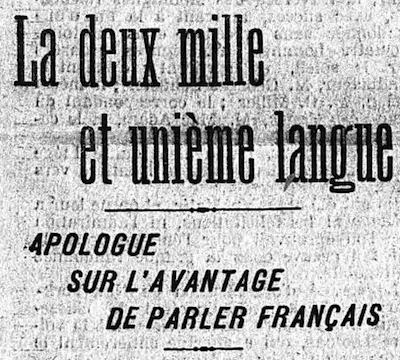
"The two-thousand-and-first language"
in their view, one too many.
A cautionary tale published in the New York Sun on September 5, 1908 shows the problem of network effects. There might have been a lot of Esperanto speakers in France at that time, but the point of the Sun piece (translated from Le Matin) was that your Esperanto wasn’t going to do you any help in Paris.

Other reading I’ve done has shown that Le Matin was fairly hostile to the Esperanto movement, in part perhaps to the appeal Esperanto had for the labor movement in Europe. The conservative newspaper does not seem to have been a fan of organized labor in any language, although the motive behind the Le Matin piece was the fear that Esperanto would reduce the prestige of French. If you want to be a truly sophisticated world traveller, you should speak French. Ask any Frenchman.

You can follow my blog on Twitter (@impofthediverse) or on Facebook. If you like this post, share it with your friends. If you have a comment just for me, e-mail me at impofthediverse@gmail.com.
This blog runs solely on ego! Follow this blog! Comment on this post! Let me know that you want to read more of it!
Wednesday, September 3, 2014

The Death of Diplomatic Discourse

And what if an American President
started giving nicknames
to world leaders?
And Esperanto was to blame.

The Washington Times reported on September 3, 1922 that the French were concerned that American slang might become the future language of diplomacy, supplanting French. Of course, it did happen that English became the international language of diplomacy, but really not because of Esperanto. I’m also going to hazard a guess that diplomats are probably still speaking in a formal register, mostly to minimize potential misunderstanding.

The French saw two horrible potential futures, and in both of them the prestige of French had been minimized. If not English, then Esperanto (perhaps worse!). This was part of a wide pattern of opposition to Esperanto by the French in the 1920s. While this article is largely about the efforts of French educators against Esperanto, the French also blocked a proposal at the League of Nations to use Esperanto as the official language of that body, once again, for fears that French would lose its prestige status.


You can follow my blog on Twitter (@impofthediverse) or on Facebook. If you like this post, share it with your friends. If you have a comment just for me, e-mail me at impofthediverse@gmail.com.
This blog runs solely on ego! Follow this blog! Comment on this post! Let me know that you want to read more of it!

Wednesday, July 16, 2014

Failing at Language? Maybe You Chose Wrong

Learn this man's
secret for speaking
a foreign language
William Alexander wrote in the New York Times about the trials of learning a foreign language.
I used to joke that I spoke French like a 3-year-old. Until I met a French 3-year-old and couldn’t hold up my end of the conversation.
I think I’ve put in more hours of learning French than Mr. Alexander (I started in 1974), and while my studies seem to include none of the things he did, I am able to read eighteenth-century French in the original. “Tonight, sweetheart, we’ll be reading Voltaire’s Zadig in French for your bedtime story.” I don’t think I’d hand Adolphe to a 3-year-old (I think it’s standard for high schoolers in France though).

But even with my abilities to read eighteenth-century novels, Le Monde, and Têtu in French, I know that my abilities to speak are somewhat more limited. I. Speak. French. Much. More. Slowly. Than. I. Speak. English. I have actually had casual conversation in French. Some years ago, I was in D.C. and was asked a question in very bad English by a French woman who was at the museums. She had trouble understanding my English, so we both switched to French.


You can follow my blog on Twitter (@impofthediverse) or on Facebook. If you like this post, share it with your friends. If you have a comment just for me, e-mail me at impofthediverse@gmail.com.
This blog runs solely on ego! Follow this blog! Comment on this post! Let me know that you want to read more of it!
Related Posts Plugin for WordPress, Blogger...